Stratum 2 — Derivation
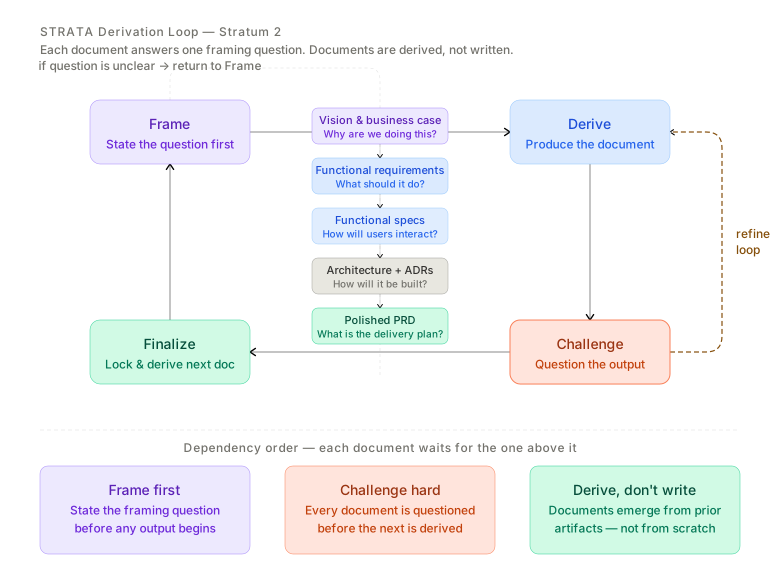
Documents are derived, not written. Every artifact answers exactly one framing question. If you cannot state the question, you are not ready to produce the document.
Stratum 2 — Derivation is the knowledge construction engine of STRATA. It takes the Classification Record produced in Stratum 1 and converts it into a complete, challenged, and finalized set of normative documents — the foundational data from which the Authority Chain (Stratum 3) and Execution Loop (Stratum 4) operate.
Stratum 1 answers: What kind of project is this? Stratum 2 answers: What do we need to know before we build it — and in what order do we need to know it?
Why This Stratum Exists
Without a structured derivation process, documents are written from instinct rather than derived from intent.
Requirements contradict the vision because no one checked. Architecture decisions are made without rationale because no ADR was written. Testing standards are aspirational rather than achievable because they were never challenged against the architecture they are supposed to verify. The document set is internally inconsistent, and every AI session that generates against it compounds the inconsistency.
Derivation enforces dependency order on understanding. You cannot answer how the system will be built before you know what it must do. You cannot plan a migration before you have a target architecture. The 7-layer mental model makes this dependency order explicit, names it, and requires it to be followed — not as a bureaucratic formality, but because understanding truly is sequential.
Key Concepts
The 7-Layer Mental Model
The thinking sequence that enforces dependency order on all Stratum 2 work. Each layer answers one fundamental question and produces one category of document artifact. Layers must be worked in sequence — a lower layer that contradicts a higher one signals an incomplete or incorrect higher layer, requiring a return to it before proceeding.
| Layer | Dimension | Question | Document category |
|---|---|---|---|
| 1 | Why | Why are we doing this? | Vision & Business Case |
| 2 | What | What should the system do? | Requirements (BRD + PRD) |
| 3 | How — Functional | How will users interact with it? | Functional Specifications |
| 4 | How — Technical | How will it be built? | Architecture |
| 5 | How — Quality | How do we ensure robustness? | NFR & Quality Plan |
| 6 | How — Transition | How do we migrate safely? | Migration Strategy |
| 7 | How — Execution | How do we deliver? | Roadmap & Delivery Plan |
Layers 1–2 are the strategic layers — business language, no implementation detail. Layers 3–5 are the design layers — bridging business intent and engineering behavior. Layers 6–7 are the delivery layers — continuity, risk, and sequencing.
Document Dependency Order
The 14 normative documents produced by Stratum 2 are produced in dependency order — the document that feeds another is produced first. The Classification Record is the root; every document traces back to it.
A lower-layer document that contradicts a higher one is not a standalone error. It is a signal that the higher-layer document is incomplete or incorrect. The correct response is to return to the higher layer, revise it, and re-derive the lower one — not to resolve the contradiction locally in the lower document.
Documents are not finalized by completion. They are finalized by surviving challenge.
Generate → Iterate → Finalize
Every Stratum 2 document passes through three stages before it is normative:
Generate — Produce a first draft from available context. The draft makes thinking visible so it can be challenged. It is a starting point, not a deliverable.
Iterate — Challenge the draft against the documents above it in the dependency chain. Does this document contradict the Vision? Does this requirement trace to a business objective? Does this architecture decision have an ADR that justifies it? Unresolved contradictions are signals that a higher-layer document needs revision — not judgment calls to be made locally.
Finalize — When the document has survived challenge, declare it normative. Commit it to the repository and version it. A finalized document that must change requires a documented reason and a version increment.
Classification Sensitivity
Not all layers produce equally weighted documents for every project type. The Classification Record from Stratum 1 determines the depth and criticality of each layer.
A Class 1 Greenfield MVP stubs or skips Layer 6 (Migration Strategy) — not because migration is unimportant in principle, but because there is nothing to migrate from. A Class 2 Established System treats Layer 6 as a first-class risk surface. Its architecture decisions are business continuity decisions; its migration strategy requires the same rigor as its architecture document.
How Practitioners Apply It
Begin with the Classification Record
Load the signed Classification Record from Stratum 1. This is the highest-authority document in the derivation chain. Every subsequent document traces to it — the classification determines which layers are full, lightweight, or stubbed.
Derive Layer 1 — Vision & Business Case
Produce the Vision & Business Case first. It is the north star for every document that follows. Challenge it: Does it honestly state why the initiative exists? Does it commit to measurable success criteria? Does it define scope boundaries explicitly? A vision document that cannot be challenged is a vision document that will fail to govern.
Work the layers in dependency order
Produce Layer 2 documents (Requirements) from Layer 1. Produce Layer 3 documents (Functional Specification) from Layer 2. Never produce a lower-layer document before the documents it depends on are finalized. Each time a lower-layer document surfaces a contradiction with a higher one, return to the higher layer — do not paper over the contradiction locally.
Use the Derivation Agent with discipline
The Derivation Agent is a governed AI persona operating under the triple-lens model (Product Philosopher, Transformation Architect, Principal Engineer). Use it to draft — then challenge what it produces. The Agent derives; it does not finalize. Finalization is a human act.
Commit and version each finalized document
Finalized documents are committed to the repository with a version reference. A finalized document that must change requires a documented reason and a version increment. Downstream documents that depend on the changed document are flagged for review.
What Goes Wrong Without It
The most common failure mode: producing documents at the wrong layer.
Architecture decisions appear in business requirements — the BRD describes how the system will be built instead of what the business needs. Implementation details appear in the vision statement — the initiative is framed in technical terms before a business objective has been stated. Requirements don't trace to business objectives — features are built because they seemed useful, not because they address a stated business need.
The deeper failure: the document set is internally inconsistent, and no one knows it until the AI sessions begin generating against it. Each session produces output that is coherent within its own context window but architecturally inconsistent with what previous sessions produced. The contradictions compound silently — visible only in the bugs that surface during integration, never traceable to their root cause in an undisciplined derivation process.
StrataProtocol.org Example
The docs/strata/2.derivation/ directory is the complete Stratum 2 output for this platform — 14 normative documents produced in dependency order.
The derivation chain for this platform is intact and navigable: the Vision & Business Case established the north star; the Business Requirements (BRD) translated it into numbered business requirements; the Product Requirements (PRD) translated those into numbered product requirements, each with its own phased implementation plan; the Engineering Standards and Testing Standards defined how code would be written and verified.
The PRD that governs this very page's content (REQ-001 — Public Framework Documentation) was derived from the BRD, which was derived from the Vision, which was derived from the Classification Record. The dependency chain is traceable in both directions.
Go deeper with a member account
Related Strata
← Previous: Stratum 1 — Classification — provides the Classification Record that is Stratum 2's first and highest-authority input. The classification determines document depth, layer weighting, and which documents are required versus stubbed.
→ Next: Stratum 3 — Authority Chain — consumes the finalized Stratum 2 documents to construct the five-node authority chain. The operative constitution (.github/copilot-instructions.md) aggregates essential constraints from the derivation document set into the AI copilot's mandate.